What Is Verticutting? A Grounds Teams Guide to Faster, Finer Football Pitches
For football grounds teams, maintaining a pitch to an elite standard is about far more than simply keeping the grass short. Surface quality, consistency and playability all depend on what is happening beneath and within the sward. The modern game is faster and more intense than ever, with managers increasingly demanding high-tempo football built around quick passing, rapid transitions and constant movement. That places greater demands on the playing surface, which must provide reliable traction, stability and ball roll while withstanding significant levels of wear. Achieving that consistency requires a healthy, resilient sward and a well-managed rootzone, with effective maintenance practices working together to ensure the pitch can perform at the highest level throughout the season.
One of the most effective maintenance practices for managing a fine turf surface is verticutting.
Used correctly and as part of a wider turf-management programme, verticutting can help produce a cleaner, denser and more upright sward while controlling thatch and lateral growth and helping the pitch deliver the consistent playing characteristics expected at the highest level of football.
What is verticutting?
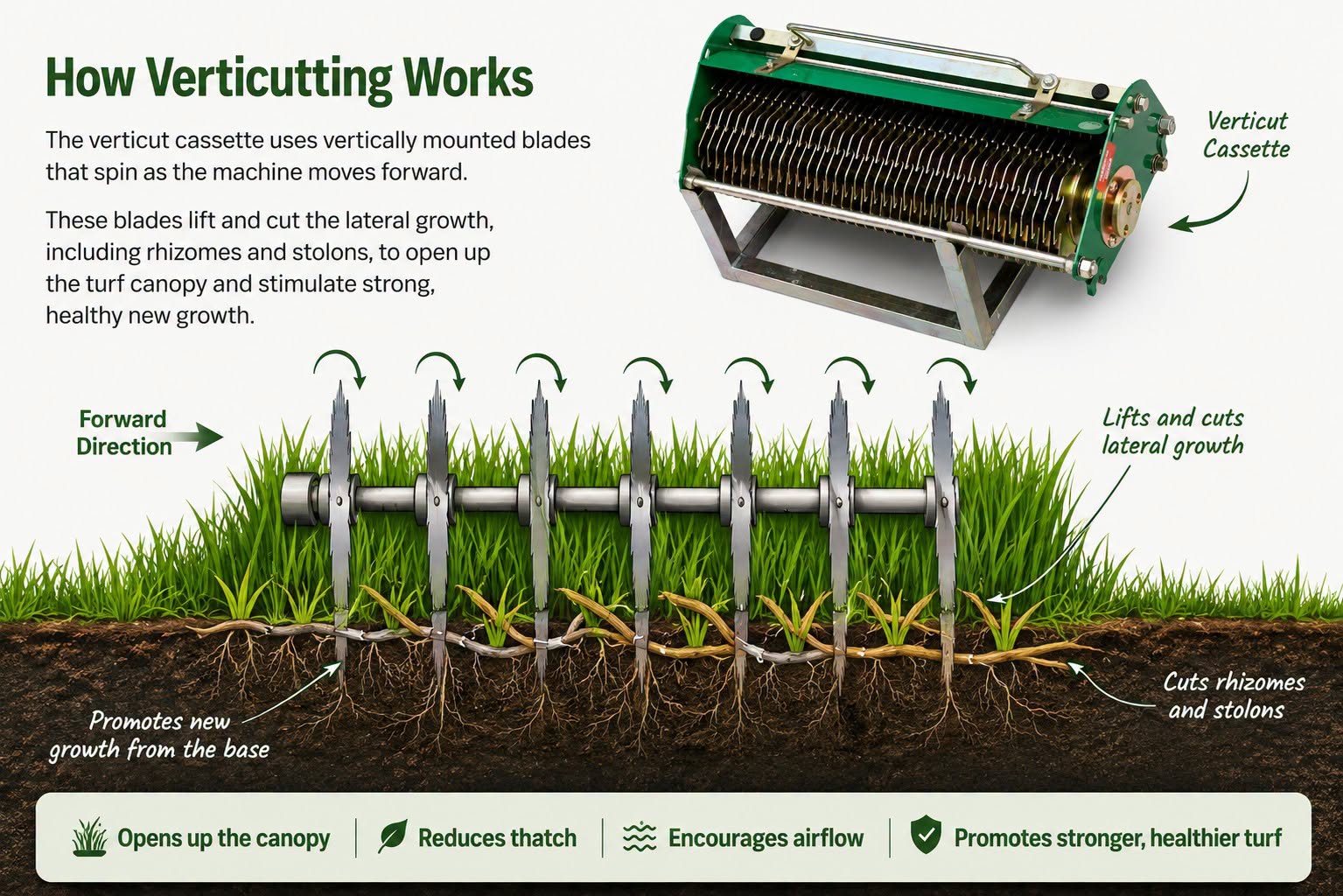
Verticutting is the process of using vertically orientated blades or discs to cut through the grass sward.
Unlike conventional mowing, which cuts the grass horizontally, verticutting works vertically through the canopy, removing excess organic material, controlling lateral growth and helping to stand the grass plants upright ahead of cutting.
It is particularly valuable on fine turf football pitches where a dense, horizontal or thatch-heavy sward can affect both the appearance and performance of the playing surface.
Regular, well-timed verticutting can help maintain a more open, upright and uniform playing surface — creating the conditions for a pitch that looks sharper and plays more consistently.
Verticutting stimulates the rhizomes and stolons to produce new, stronger growth and encourage a denser, more uniform playing surface.
Why does verticutting matter on a football pitch?
At any level; professional or grassroots, small differences in surface performance can matter.
Players need a pitch that provides predictable ball movement, consistent footing and reliable interaction between the ball, boots and turf. Groundspeople therefore need to manage not just grass height, but also sward density, thatch, lateral growth and surface presentation.
This is where verticutting becomes an important part of the maintenance programme.
1. Faster, more consistent ball roll
A cleaner, more upright sward can help reduce excessive interference between the grass canopy and the ball.
For football, this can contribute to quicker and more predictable ball movement, particularly when combined with appropriate mowing, irrigation and surface preparation.
For a grounds team, that means another tool for fine-tuning the characteristics of the playing surface.
2. Controls lateral grass growth
Grass doesn't always grow upwards.
Over time, lateral growth can create a dense, matted canopy that reduces the clean presentation and performance of the surface.
Verticutting helps remove and control this lateral growth, encouraging a more upright sward.
The result is a surface that can look cleaner, sharper and more uniform — exactly what you want when preparing a pitch for matchday.
3. Helps manage thatch
Thatch is a layer of living and dead organic material that develops within the turf canopy.
A certain amount of organic matter is normal, but excessive accumulation can create problems for turf performance and management, for example when it's wet it can hold water.
Regular verticutting can help manage the build-up of thatch and unwanted organic material, keeping the sward under control as part of an integrated maintenance programme.
This can also help maintain better conditions for subsequent mowing and other cultural practices.
4. Helps control unwanted species
Fine turf football pitches need to maintain a strong, desirable grass population.
Species such as annual meadow grass (Poa annua) can become increasingly prevalent where conditions favour them.
Verticutting can form part of a wider strategy to manage the ingress and spread of unwanted species by physically disrupting the sward and controlling excessive surface growth.
It is not a standalone solution for species management, but used alongside appropriate mowing, nutrition, irrigation, aeration and overseeding programmes, it can play an important role.
5. Encourages an upright, healthy-looking sward
A vertically managed sward can provide a noticeably different appearance to a pitch.
Instead of grass lying over and creating a matted canopy, verticutting helps encourage the plants to stand more upright.
That can improve the visual quality of the pitch, enhance striping and presentation following mowing, and contribute to the sharp, professional appearance expected from elite football surfaces.
6. Improves surface presentation
For professional grounds teams, presentation matters.
A pitch needs to look right before the first whistle — but good presentation should also reflect good turf management.
Verticutting helps create a cleaner canopy by removing excess lateral growth and managing the sward, allowing mowing to produce a more defined finish.
The result can be a pitch that looks tighter, cleaner and more professionally maintained.
7. Helps maintain consistency across the pitch
Consistency is one of the biggest objectives in professional pitch management.
Players shouldn't encounter significant changes in grass density or surface behaviour from one area of the pitch to another or one pitch to the other.
Used appropriately, verticutting helps grounds teams maintain control over the sward and can form part of a regular programme designed to keep turf growth more uniform.
Why regular verticutting matters
Verticutting shouldn't necessarily be viewed as a once-in-a-while renovation operation.
For high-quality fine turf, regular, controlled use can be much more effective. Done at least once a month football clubs can see instant results.
The frequency and intensity should always be matched to the pitch, grass species, season, weather conditions, growth rate and fixture schedule.
Too aggressive, too frequently, or under unsuitable conditions can put unnecessary stress on the turf.
But when correctly integrated into a professional maintenance programme, regular verticutting provides grounds teams with another way to keep the sward under control throughout the season.
The right cassette makes a difference
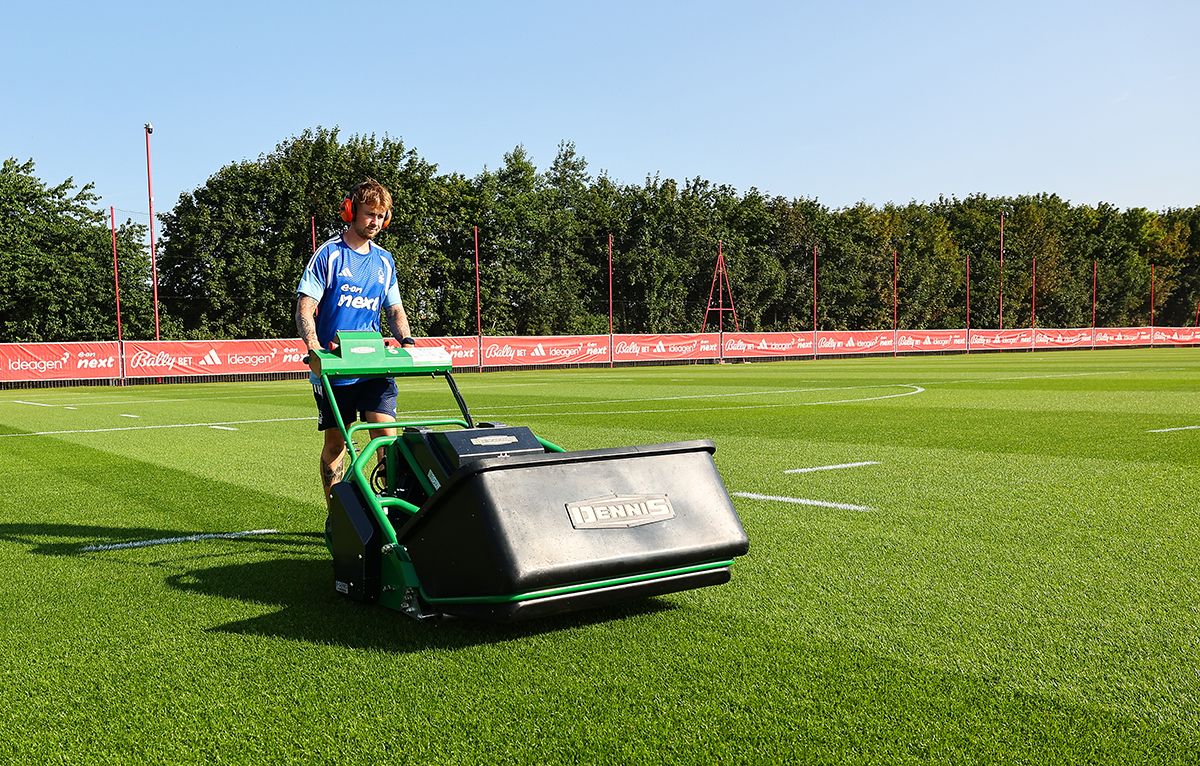
For professional grounds teams, the equipment needs to match the demands of the job. Dennis manufacture a range of cassette mowers that allow you to replace the cutting cylinder with a verticut cassette in seconds.
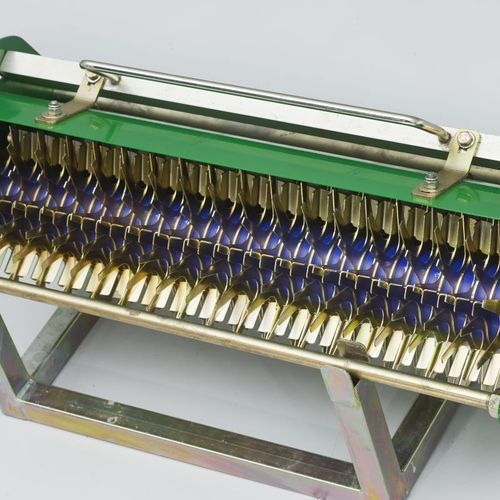
The Dennis Verticutter cassette features 1 mm thick, 10-fingered replaceable discs, designed for regular use on fine turf.
For heavier-duty requirements, the Verticutter Tungsten Tipped cassette features tungsten-tipped blades designed to withstand regular, demanding use.
Both provide groundspeople with a dedicated solution for vertical sward management without requiring a separate specialist machine.
Built for professional pitch maintenance
The cassette system also makes changing attachments quick and straightforward.
Time to change: just 30–60 seconds.
That means less downtime and more flexibility for grounds teams working around tight maintenance windows and demanding fixture schedules.
When every hour counts between matches, being able to change from one maintenance operation to another quickly can make a real difference.
When should you verticut?
There isn't one universal verticutting schedule for every football pitch.
The right approach depends on:
- Grass species and sward composition
- Growth rate
- Thatch levels
- Amount of lateral growth
- Time of year
- Soil and weather conditions
- Fixture schedule
- Desired playing characteristics
- Overall maintenance programme
The important thing is to read the pitch.
A professional grounds team can use verticutting strategically — increasing or reducing its frequency and intensity according to what the surface needs.
Verticutting as part of the bigger picture
Verticutting works best when it isn't treated in isolation.
For an elite football pitch, it should sit alongside a wider programme incorporating:
Mowing + verticutting + aeration + nutrition + irrigation + overseeding + brushing + rolling + regular monitoring.
Each operation has a role to play.
Verticutting gives grounds teams another way to manage the sward, control organic material and lateral growth, and maintain the playing surface required for modern football.
A sharper sward. A faster surface. A better pitch
For professional football, the difference between a good pitch and an exceptional one can come down to the detail.
Verticutting is one of those details.
By helping control thatch and lateral growth, encouraging a more upright sward, managing unwanted species and supporting a cleaner playing surface, regular verticutting can contribute to faster ball movement, improved consistency and a sharper matchday presentation.
And with a dedicated cassette that can be changed in as little as 30–60 seconds, it's a practical operation that can be built into even demanding professional maintenance schedules.
For groundspeople striving to maintain elite playing standards, verticutting isn't simply about cutting grass vertically. It's about taking greater control of the sward and ultimately, the way the pitch plays.
See our mowers suitable for football here